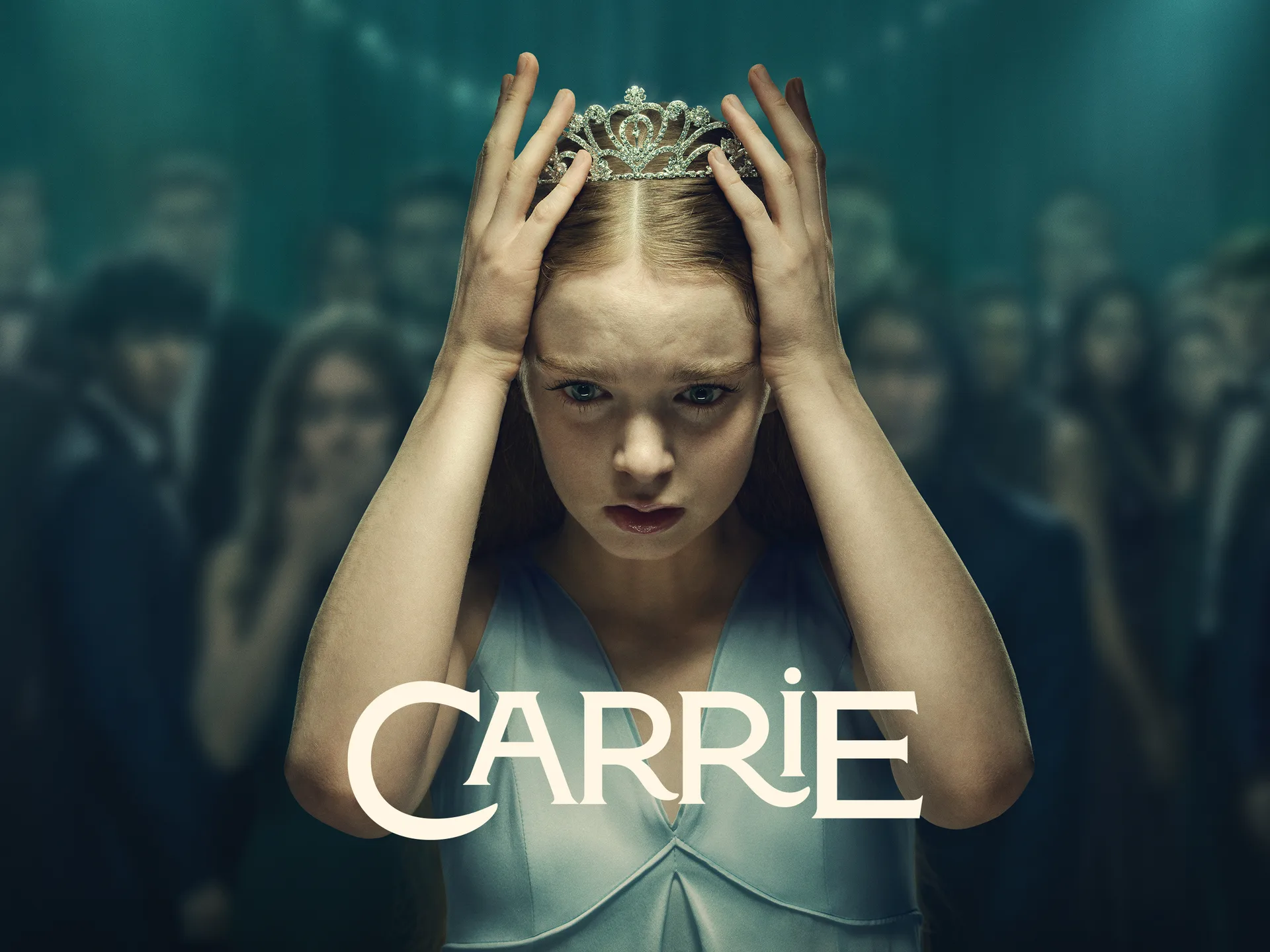
- Carrie TV series review: Mike Flanagan's 8-episode adaptation of Stephen King's novel, streaming on Prime Video since October 7, 2026.
- Tone: Character-driven psychological horror, not a jump-scare monster story.
- Best for: Viewers who enjoy slow-building tension, Stephen King adaptations, and supernatural drama.
- Content warning: Bullying, religious extremism, family abuse, and emotionally intense material throughout.
- Bottom line: A serialized tragedy-hybrid that rewards patience and emotional investment.
Carrie TV Series Review Overview
This Carrie TV series review breaks down what works, what divides opinion, and who should press play on Mike Flanagan's eight-episode adaptation for Prime Video. Unlike the 1976, 2002, and 2013 film versions, this adaptation uses the long-form television format to slow down and examine Carrie White's world with far more patience than any single movie could afford.
The series presents itself as a supernatural horror drama built around Carrie White, a socially isolated teenager whose psychic abilities emerge during a period of intense personal and family conflict. Flanagan's involvement signals exactly what long-time horror viewers should expect: emotionally layered, character-centered horror rather than spectacle-first filmmaking.
Video Highlights from the official trailer:
- Establishes Carrie White, school bullying, and family conflict as the three pillars
- Teases telekinetic power awakening tied to emotional repression
- Prom-relevant imagery and a cold, dread-soaked atmosphere
This review stays spoiler-free in its assessments. Where deeper thematic analysis requires plot specifics, we label the content clearly so you can decide how much you want revealed before watching.
What Works: Strengths
Serialized Depth
- Eight episodes instead of one film
- Room for family and community context
- Gradual escalation of dread
Character Focus
- Carrie as a full person, not a set piece
- Margaret's extremism given backstory space
- Classmates with actual motivations
Thematic Horror
- Horror rooted in cruelty and repression
- Telekinesis as metaphor for suppressed rage
- Tragedy structure alongside supernatural beats
The strongest asset is time. A two-hour film must rush toward the infamous climax; a series can spend episodes establishing the social ecosystem of the school, the texture of the White household, and the slow accumulation of humiliation that makes the ending land as tragedy rather than spectacle.
| Strength | Why It Matters | Viewer Impact |
|---|---|---|
| Slow-burn pacing | Tension compounds across episodes | Rewards patient viewers |
| Expanded cast arcs | Classmates and teachers get real dimension | Emotional stakes feel earned |
| Psychological realism | Bullying depicted as sustained, systemic pressure | Heavier, more honest horror |
| Flanagan's direction | Known for character-first supernatural drama | Consistent tonal control |
The adaptation's smartest move is framing the supernatural element as an extension of emotional repression. When the horror arrives, it feels inevitable rather than arbitrary.
What Divides Viewers: Weaknesses
No honest Carrie TV series review skips the friction points. The pacing that rewards patient viewers will test others, and the material itself is unrelentingly heavy.
| Potential Issue | Explanation | Who It Affects Most |
|---|---|---|
| Slow first episodes | Setup-heavy opening before major horror beats | Viewers expecting fast scares |
| Emotional heaviness | Bullying and abuse depicted in sustained detail | Sensitive viewers |
| Familiar story | Core plot is widely known from prior adaptations | Audiences wanting surprises |
| Limited gore early | Psychological dread over graphic violence | Gore-forward horror fans |
The series contains depictions of bullying, public humiliation, religious extremism, and family abuse. Its most difficult material comes from sustained psychological pressure rather than constant graphic violence. Mature audiences only.
Carrie vs. Novel and Film Adaptations
The comparison below situates the series against Stephen King's 1974 novel and the three major screen adaptations.
| Adaptation | Format | Story Focus | Horror Expression | Best For |
|---|---|---|---|---|
| 1974 novel | Novel | Multi-viewpoint psychological horror with documentary-style material | Internal fear, social realism, supernatural escalation | Source-material purists |
| Carrie (1976) | Feature film | Condensed, visually driven coming-of-age horror | Performance, composition, suspense | Classic-film fans |
| Carrie (2002) | TV film | Modernized retelling with more exposition | TV-drama structure with supernatural suspense | Casual retelling viewers |
| Carrie (2013) | Feature film | Contemporary update on the central conflict | Modern effects plus psychological horror | Modern-film audiences |
| TV series (2026) | 8-episode series | Serialized exploration of characters and community | Sustained tension, gradual development | Long-form horror viewers |
The series format is the deciding factor. Where each film compresses, the series expands, giving the world around Carrie, her family, and her classmates room to breathe.
For viewers deciding between versions: the 1976 film remains the most influential screen interpretation, while the series offers the deepest character exploration. They complement rather than replace each other.
Is Carrie Worth Watching? Decision Guide
Follow this quick decision flow to determine whether the series fits your taste.
Check Your Horror Preference
If you prefer character-driven horror like slow-building supernatural drama over jump scares or slasher pacing, proceed. If you want fast gore, this series will frustrate you.
Assess Content Tolerance
Confirm you are comfortable with sustained depictions of bullying, religious control, and family abuse. The emotional weight is constant, not occasional.
Consider Your King Familiarity
Prior knowledge of the story is not required. Knowing the ending in advance does not ruin the experience, since the series' value lies in the journey and characterization.
Commit to the Format
Eight episodes reward binge or near-binge viewing. The slow first stretch pays off only if you stay through the escalation.
| Viewer Type | Match Level | Reasoning |
|---|---|---|
| Flanagan fans | ★★★★★ | His signature character-first horror throughout |
| Stephen King readers | ★★★★☆ | Faithful themes with expanded context |
| General horror fans | ★★★☆☆ | Heavy on drama, light on early scares |
| Casual viewers | ★★★☆☆ | Demanding tone and subject matter |
| Sensitive viewers | ★★☆☆☆ | Sustained distressing content |
The series streams exclusively on Prime Video. Check the official Prime Video Carrie page for regional availability, as access may vary by location.
Before You Start Watching:
- Confirm Prime Video access in your region
- Review the content advisories for bullying and abuse
- Decide whether to read the novel first or after
- Plan an 8-episode viewing window
- Watch the official trailer to calibrate expectations
Final Verdict and FAQ
Our overall Carrie TV series review verdict: a strong, emotionally serious adaptation that treats Stephen King's debut novel as a tragedy first and a horror story second. It will not satisfy viewers who want relentless scares, but for audiences who value atmosphere, characterization, and thematic depth, it stands among the more thoughtful King adaptations on television.
Recommended for mature horror audiences, Stephen King readers, and fans of character-driven supernatural drama. The serialized format is the adaptation's greatest asset.
Q: Is the Carrie TV series a remake of the 1976 movie?
No. It is a new adaptation of Stephen King's 1974 novel created by Mike Flanagan for Prime Video. It is a serialized 8-episode series, not a remake of any prior film, and it expands the characters and community far beyond what a single film could cover.
Q: How many episodes does the Carrie TV series have?
The series runs 8 episodes and premiered on Prime Video on October 7, 2026. All episodes are available for streaming on the official Prime Video title page.
Q: Is the Carrie TV series scary or more of a drama?
It blends both. The horror builds slowly from psychological sources such as bullying, repression, and family abuse, with telekinesis serving as the supernatural engine. Viewers who enjoy slow-building tension will find it far scarier than viewers expecting constant jump scares.
Q: Do I need to read the novel or watch the films first?
No. The series works as a standalone story. Prior familiarity with the 1976 film or the novel enriches the comparison but is not required, since the series spends its extended runtime establishing everything a new viewer needs.