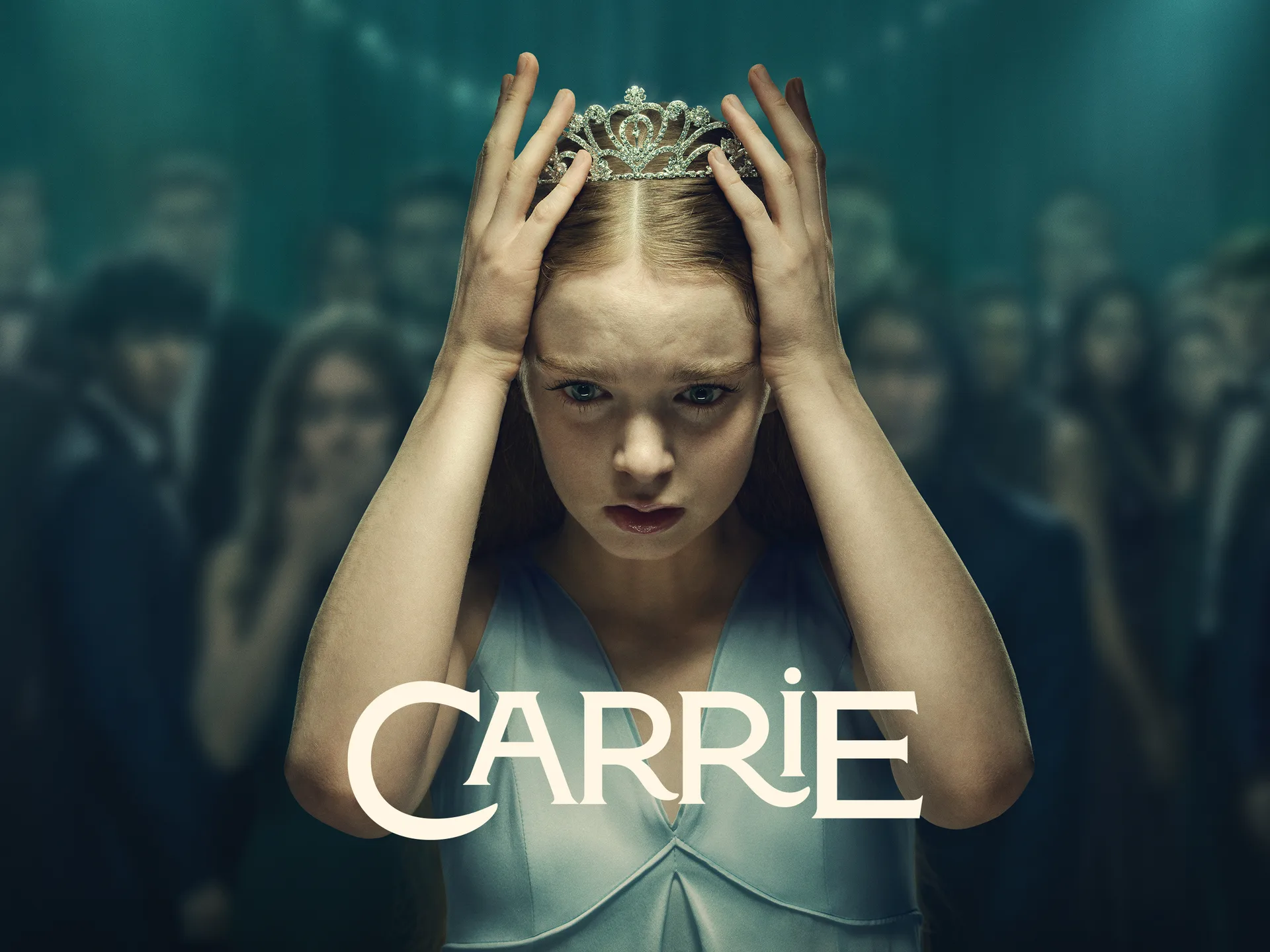
- Carrie TV series review: Mike Flanagan's 8-episode Prime Video adaptation of Stephen King's novel.
- Released October 7, 2026: All episodes are now streaming on Prime Video.
- Character-driven horror: Expect psychological tension and slow-building dread, not constant gore.
- Best for: Stephen King readers, Flanagan fans, and viewers who enjoy tragedy-inflected horror.
- Spoiler policy: This review keeps major plot points unrevealed until clearly marked sections.
Carrie TV Series Review: First Impressions
The Carrie TV series arrived on Prime Video on October 7, 2026, as an eight-episode limited series from Mike Flanagan, adapting Stephen King's 1974 debut novel. Our Carrie TV series review finds the show trading the jump-scare economy of earlier film versions for the long-form, character-first approach Flanagan is known for.
Video Highlights:
- Establishes Carrie White, her mother, and the school environment
- Telekinetic powers linked to emotional pressure
- Prom-night imagery framed as tragedy, not spectacle
The series follows Carrie White, a socially isolated teenager caught between a hostile school environment and a controlling, deeply religious mother. As her telekinetic abilities awaken, the show builds toward the collision between bullying, repression, and power that defines King's story.
| Series Fact | Detail |
|---|---|
| Format | Limited series, 8 episodes |
| Platform | Prime Video |
| Premiere date | October 7, 2026 |
| Creator | Mike Flanagan |
| Source | Stephen King's 1974 novel |
| Genre | Psychological / supernatural horror |
This review keeps spoilers out of the first sections. The ending discussion near the bottom is clearly flagged before any major reveals appear.
Cast and Characters: Who Carries the Show
Any Carrie TV series review hinges on its lead performance, and the show places enormous weight on the young cast playing Carrie White, Sue Snell, and Chris Hargensen. Margaret White, Carrie's mother, functions as the story's second engine of horror, and the serialized format gives the mother-daughter relationship more room than any film version allowed.
Carrie White
- Protagonist carrying the emotional core
- Powers tied to repression and rage
- Sympathy over spectacle
Margaret White
- Controlling, religiously extreme mother
- Source of domestic horror
- Deeper arc than film versions
Sue & Chris
- Contrasting classmates: empathy vs. cruelty
- Drive the school-conflict storyline
- Expanded roles in series format
| Character | Role | Story Function |
|---|---|---|
| Carrie White | Protagonist | Isolation, awakening power, tragedy |
| Margaret White | Mother | Oppression, fear, control at home |
| Sue Snell | Classmate | Guilt, empathy, attempted amends |
| Chris Hargensen | Antagonist | Deliberate bullying and escalation |
The eight-episode structure is the series' biggest asset. Where the 1976 film had to compress, the show can let relationships, small cruelties, and quiet dread accumulate across hours of screen time.
Story and Themes: How the Adaptation Works
The series stays anchored to King's central premise while shifting emphasis toward the social conditions that produce the tragedy. Bullying is treated as a sustained system rather than a single inciting incident, and the show connects school cruelty, religious extremism, and family abuse into one escalating pressure chamber.
Core themes:
- Alienation and adolescence — Carrie's isolation is rendered in grounded, realistic detail
- Group cruelty — peer humiliation and institutional failure drive the plot
- Religion and control — Margaret's extremism shapes Carrie's sense of self
- Telekinesis as metaphor — the power literalizes suppressed emotion
- Tragedy over spectacle — the horror lands as grief, not just shock
| Theme | How the Series Handles It | Impact |
|---|---|---|
| Bullying | Sustained, systemic portrayal across episodes | High |
| Family control | Expanded Margaret storyline | High |
| Supernatural power | Gradual awakening tied to emotion | Medium-High |
| Coming of age | Interwoven with horror beats | Medium |
The series depicts bullying, public humiliation, religious extremism, and family abuse. Its heaviest material is psychological rather than graphically violent, but it is emotionally intense and aimed at mature viewers.
Carrie TV Series vs. Movies and Novel
A fair Carrie TV series review has to weigh it against its predecessors. Every adaptation of King's novel makes different trade-offs between compression and depth.
| Adaptation | Format | Strength | Best For |
|---|---|---|---|
| 1974 novel | Novel | Documentary-style structure, original text | Purists |
| Carrie (1976) | Feature film | Iconic performances, visual classic | Classic horror fans |
| Carrie (2002) | TV film | More plot exposition | Casual TV viewers |
| Carrie (2013) | Feature film | Modern effects, contemporary setting | Newer audiences |
| TV series (2026) | 8-episode series | Long-form character depth | Flanagan fans, King readers |
Read or rewatch the source
Start with King's novel or the 1976 film to understand the compressed version of the story the series expands.
Watch the series in order
The serialized build depends on cumulative tension; episodes are designed to be watched sequentially.
Compare the treatment of Margaret
Notice how the series gives the mother-daughter conflict far more screen time than any film version.
Evaluate the climax as tragedy
Judge the ending by whether it lands as accumulated harm rather than a single night of horror.
If you loved Flanagan's earlier character-focused horror work, go in expecting emotional slow-burn storytelling rather than a remake of the 1976 film's beats.
Is Carrie Worth Watching? The Verdict
Our verdict: yes, for the right viewer. The Carrie TV series succeeds as a character-driven tragedy that uses horror as its language. Viewers seeking fast pacing or constant scares may find the build slow, but that patience is the point — the format lets the cruelty, repression, and grief register with real weight.
Watch the series if you:
- Enjoy slow-building, character-centered horror
- Are a Stephen King reader or adaptations collector
- Liked Mike Flanagan's previous series
- Prefer tragedy and theme over pure spectacle
- Want a fuller version of the Carrie White story
Carrie streams exclusively on Prime Video, with all 8 episodes available since October 7, 2026. Check the official Prime Video page for regional availability and subtitles.
FAQ
Q: Is the Carrie TV series a remake of the 1976 movie?
No. It is a fresh adaptation of Stephen King's 1974 novel created by Mike Flanagan for Prime Video. It expands the story across eight episodes rather than remaking any specific film.
Q: How many episodes does the Carrie TV series have?
The series runs 8 episodes, all released on Prime Video on October 7, 2026.
Q: Is the Carrie TV series very gory?
The horror is primarily psychological and emotional. It contains bullying, humiliation, and family abuse, but its intensity comes from sustained tension rather than constant graphic violence.
Q: Do I need to read the book or watch earlier films first?
No. The series stands on its own, but familiarity with the novel or the 1976 film will deepen your appreciation of what the longer format adds.