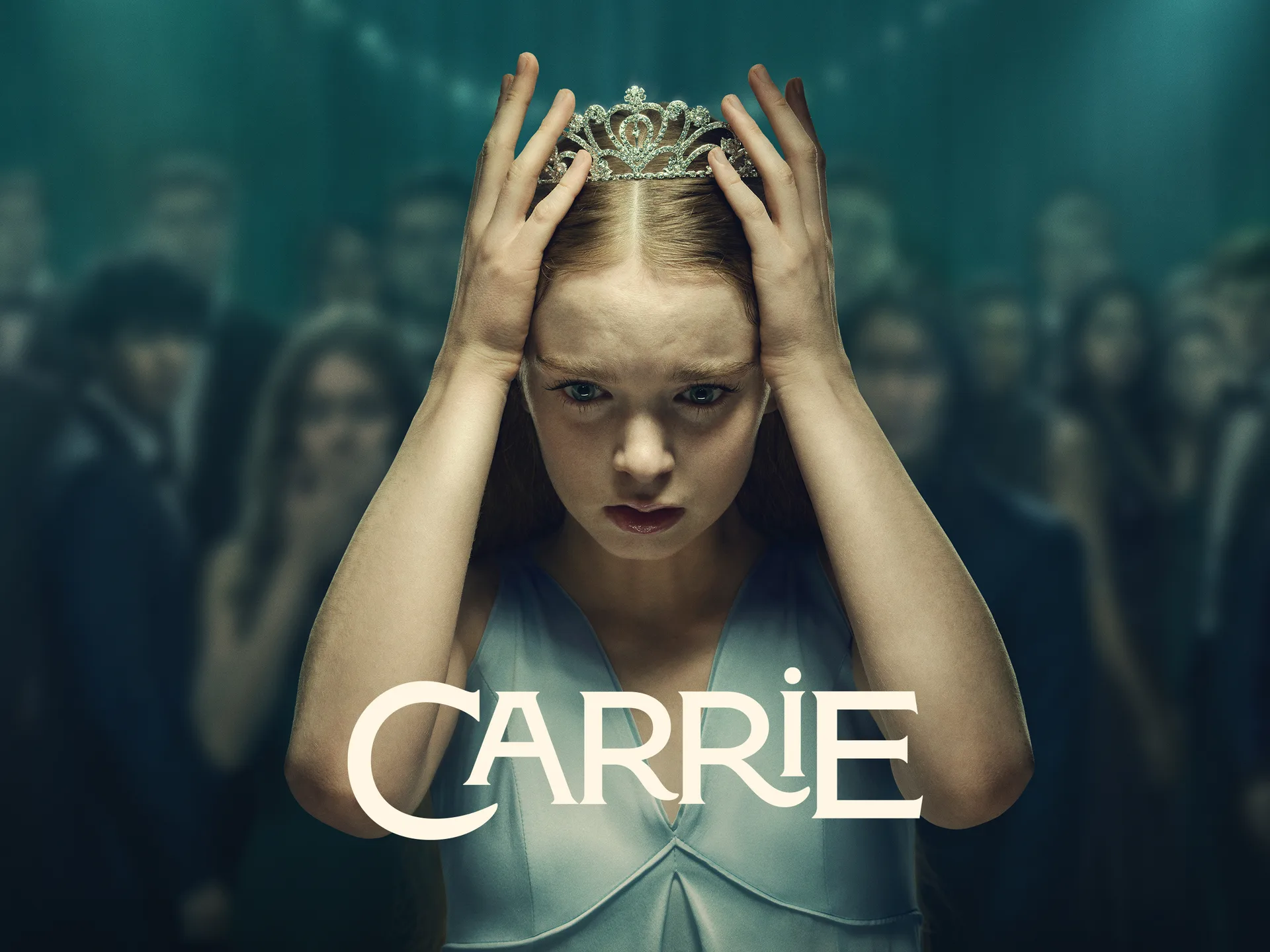
- Carrie TV series Stephen King adaptation is an 8-episode psychological horror series on Prime Video, released October 7, 2026.
- Mike Flanagan serves as series creator, bringing his character-driven horror approach to the source novel.
- Carrie White's telekinesis links supernatural horror to themes of bullying, repression, and family control.
- The series format expands characters and community beyond what any single film adaptation could cover.
- Mature content warning: the story includes bullying, religious extremism, and family abuse.
Carrie TV Series Stephen King Adaptation: Overview
The Carrie TV series Stephen King adaptation reimagines King's 1974 debut novel as an eight-episode limited series for Prime Video, developed by modern horror auteur Mike Flanagan. The series premiered on October 7, 2026, and treats the material as a psychological horror drama rather than a conventional monster narrative.
Video Highlights:
- The official trailer establishes Carrie White, school bullying, and telekinetic awakening
- The tone blends grounded character drama with supernatural suspense
- The prom and family conflicts anchor the central tragedy
The series focuses on Carrie White, a socially isolated teenager whose difficult home life with her controlling, deeply religious mother Margaret intersects with a hostile school environment and the emergence of her telekinetic abilities. You can verify current availability on the official Prime Video page and explore the Stephen King official Carrie page for source-material background.
Series at a Glance
| Detail | Information |
|---|---|
| Format | Limited series, 8 episodes |
| Platform | Prime Video |
| Release date | October 7, 2026 |
| Status | Released |
| Source | Stephen King's 1974 novel Carrie |
| Developer | Mike Flanagan / Amazon MGM Studios |
| Genre | Psychological horror, supernatural drama |
Approach the series as character-driven horror. The most difficult material stems from sustained social and psychological pressure — bullying, humiliation, and domestic control — rather than constant graphic violence.
Main Characters and Cast
Carrie's story is driven by relationships: the pressures her mother, classmates, and community place on her shape every escalation toward the tragic climax.
Carrie White
- Protagonist with telekinetic abilities
- Socially isolated teenager
- Embodies themes of repression and power
Margaret White
- Carrie's controlling, religious mother
- Shapes Carrie's fear, guilt, and identity
- The oppressive force of the home
Sue Snell
- Classmate offering a contrasting perspective
- Connected to guilt, empathy, and amends
- Bridges school dynamics to Carrie's fate
Chris Hargensen
- Antagonistic classmate
- Represents deliberate bullying
- Drives escalation toward the climax
Stephen King
- Source author of the 1974 novel
- Provides characters and thematic foundation
Mike Flanagan
- Series creator
- Known for character-focused horror drama
Character Function Comparison
| Character | Role | Primary Function | Conflict Source |
|---|---|---|---|
| Carrie White | Protagonist | Emotional and supernatural core | Home and school pressure |
| Margaret White | Mother | Oppressive home force | Religious extremism, control |
| Sue Snell | Classmate | Moral contrast and empathy | Guilt and attempted amends |
| Chris Hargensen | Antagonist | Escalation engine | Cruelty and revenge |
| Teachers/Community | Supporting | Context and institutional failure | Inaction amid known bullying |
Character discussions in later sections reference plot developments and the ending. Read the Ending Explained section only after watching the full series.
Telekinesis and Powers Explained
Carrie's telekinetic ability functions as both the supernatural engine of the horror and a metaphor for emotion suppressed too long. The series links the power's growth directly to her emotional state.
How the Powers Work
| Power Aspect | Description | Story Connection |
|---|---|---|
| Awakening | Emerges under fear and confusion | Early episodes, grounded drama |
| Growth | Strengthens with emotional pressure | Bullying and home conflict |
| Trigger | Anger and humiliation | Links repression to horror |
| Loss of control | Emotion overrides restraint | Climax and tragedy |
| Thematic role | Metaphor for suppressed rage | Reframes horror as tragedy |
The power begins as a source of confusion and fear, develops into the defining force of the climax, and ultimately reflects the pressure imposed on Carrie by everyone around her.
The supernatural horror is inseparable from the social horror. Carrie's telekinesis externalizes what she cannot express — the series treats the power as the visible form of accumulated harm, not a separate fantasy element.
Ending Explained: Step by Step
This section contains major spoilers. The ending brings together the series' themes of bullying, religious repression, family abuse, and supernatural power.
Isolation Reaches a Breaking Point
Pressure accumulated at home and school leaves Carrie with fewer emotional and social protections as the conflict escalates. The ending is prepared by a long pattern of cruelty, not one isolated event.
Telekinesis Becomes the Central Force
Carrie's ability shifts from confusion to the defining force of the climax. Her emotional state and control of the power become inseparable.
The School Conflict Turns Tragic
Humiliation and revenge collide in the story's major turning point, transforming personal cruelty into public catastrophe — a supernatural disaster that is also the consequence of sustained abuse.
The Family Conflict Reasserts Itself
Even after the school conflict, the final confrontation with Margaret shows how religious extremism and parental control made the tragedy possible in the first place.
The Meaning of the Ending
Carrie's powers offer escape from helplessness but no path to safety or belonging. The ending works as both supernatural horror and a tragedy about accumulated harm.
The climax is best understood as convergence: every pressure system in Carrie's life — peers, family, and institutions — fails her at once, and the supernatural simply reveals the scale of that failure.
Carrie Adaptations Compared
Carrie has been adapted repeatedly across film and television, and each version emphasizes different parts of King's story.
| Adaptation | Format | Story Focus | Best For |
|---|---|---|---|
| 1974 novel | Novel | Multi-viewpoint psychological horror with documentary-style context | Readers wanting the source material |
| Carrie (1976) | Feature film | Visually driven coming-of-age horror | The classic screen interpretation |
| Carrie (2002) | TV film | Expanded exposition in TV format | A television-oriented retelling |
| Carrie (2013) | Feature film | Modernized school culture and bullying | Contemporary film fans |
| TV series (2026) | 8-episode series | Serialized depth for characters and community | Long-form storytelling fans |
The series format is the key differentiator: eight episodes give Carrie, her family, her classmates, and the surrounding community room to develop gradually, allowing the causes and consequences of her isolation to be examined in far more detail than a single feature-length adaptation permits.
Newcomers can watch the series first, then read the 1974 novel for its documentary-style structure, then the 1976 film for comparison. Longtime King readers will notice how serialization recovers context the films had to cut.
Viewing Checklist
Complete Carrie Experience:
- Watch all 8 episodes on Prime Video
- Read Stephen King's original 1974 novel
- Compare with the 1976 film adaptation
- Review the official trailer and teaser
- Explore character and ending analyses
FAQ
Q: What is the Carrie TV series Stephen King adaptation about?
It is an 8-episode Prime Video limited series developed by Mike Flanagan, adapting Stephen King's 1974 novel. It follows Carrie White, an isolated teenager whose oppressive home life and hostile school environment intersect with the emergence of her telekinetic abilities.
Q: Where can I watch the Carrie TV series?
The series streams on Prime Video, with all 8 episodes available since October 7, 2026. Check the official Prime Video title page for current regional availability and subscription requirements.
Q: How is the TV series different from the Carrie movies?
The serialized format expands Carrie's family, classmates, and community across eight episodes, allowing gradual tension and deeper character development than the 1976, 2002, or 2013 film versions, which condense the story into a single feature-length runtime.
Q: Is the Carrie TV series worth watching?
It suits viewers who enjoy character-driven horror, Stephen King adaptations, and slow-building supernatural tension. Note that it contains bullying, humiliation, religious extremism, and family abuse, making it appropriate for mature horror audiences.