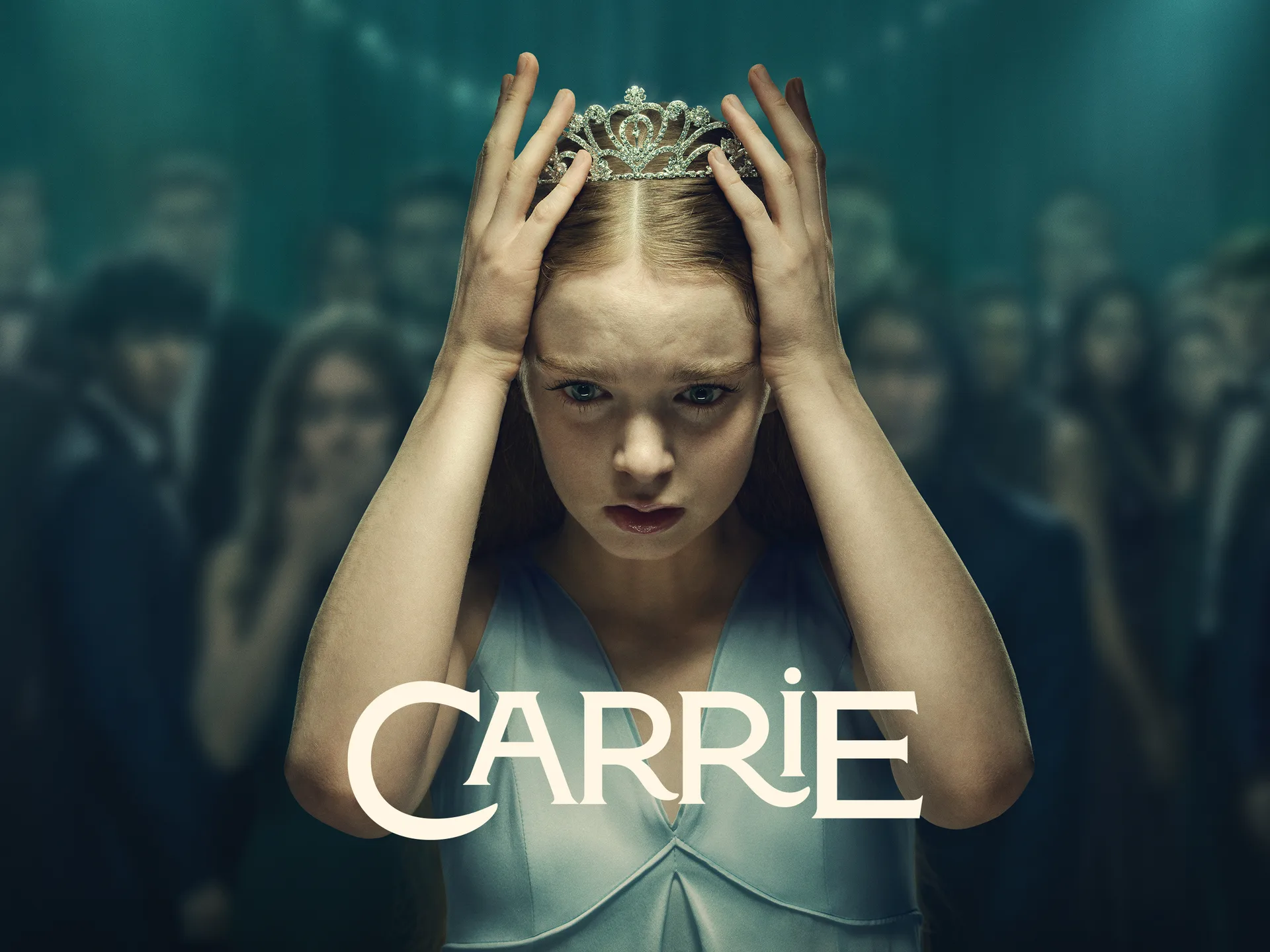
- Carrie TV series plot centers on Carrie White, an isolated teen whose telekinetic powers awaken under relentless bullying and family control.
- The series spans 8 episodes on Prime Video, released October 7, 2026, from creator Mike Flanagan.
- The story merges psychological horror, coming-of-age drama, and supernatural suspense drawn from Stephen King's 1974 novel.
- The climax turns private cruelty into public catastrophe, reframing the story as tragedy as much as horror.
- Spoiler-safe reading: the ending breakdown is clearly marked before major reveals.
What Is the Carrie TV Series Plot About?
The Carrie TV series plot follows Carrie White, a socially withdrawn high-school student trapped between two hostile worlds: an oppressive, religiously extreme home ruled by her mother Margaret White, and a cruel school environment where bullying and humiliation are routine. As emotional pressure mounts from both directions, Carrie discovers she possesses telekinetic abilities that grow stronger alongside her fear and anger. Mike Flanagan's eight-episode adaptation for Prime Video expands Stephen King's compact novel into a serialized drama, giving the town, the school, and Carrie's relationships room to develop gradually before the story's devastating conclusion.
Video Highlights:
- Introduces Carrie White and the series' core conflicts: bullying, family, and power
- Establishes the tone as character-driven psychological horror
- Shows the first glimpses of telekinetic ability in a grounded school setting
- Released ahead of the October 2026 Prime Video launch
Sections 1–3 stay spoiler-free. The ending breakdown in Section 5 contains major spoilers—read it only after finishing all 8 episodes.
Main Characters and Their Role in the Plot
The Carrie TV series plot is driven by a tight ensemble. Each character represents a distinct pressure acting on Carrie, and the serialized format lets these relationships deepen across multiple episodes rather than compressing them into a single film's runtime.
| Character | Role | Function in the Plot |
|---|---|---|
| Carrie White | Protagonist | Isolated teen whose telekinesis awakens; embodies themes of repression, bullying, and power |
| Margaret White | Carrie's Mother | Religious extremist whose control shapes Carrie's fear, guilt, and identity |
| Sue Snell | Classmate | Guilt-driven figure seeking amends; connects school dynamics to the climax |
| Chris Hargensen | Antagonistic Classmate | Source of deliberate cruelty whose actions escalate toward catastrophe |
| Stephen King | Source Author | Wrote the 1974 novel providing the premise, characters, and themes |
| Mike Flanagan | Series Creator | Known for character-focused horror; shapes the adaptation's tone |
Carrie White
- Protagonist and emotional core
- Powers tied to suppressed emotion
- Struggles for acceptance and control
Margaret White
- Oppressive home force
- Religious extremism and control
- Central to the final confrontation
Sue Snell
- Contrasting perspective
- Guilt, empathy, attempted amends
- Links social choices to consequences
Unlike the 1976 and 2013 films, the TV series uses eight episodes to examine the causes of Carrie's isolation in detail—her community, school institutions, and family history—before the horror fully erupts.
Telekinesis and the Story's Escalation
Carrie's telekinetic ability is both the supernatural engine of the plot and a metaphor for emotion suppressed too long. The series connects her emotional state directly to her control over the power, so escalation in the story tracks escalation in Carrie's inner life.
| Story Phase | Power Status | Emotional Driver |
|---|---|---|
| Series setup | Confusing, uncontrolled | Isolation at home and school |
| Middle episodes | Growing, unstable | Rising humiliation and fear |
| Final movement | Central force of the climax | Anger and betrayal peak |
| Aftermath | Fully unleashed | Loss of all social protection |
The plot involves bullying, public humiliation, religious extremism, and family abuse. The horror builds from sustained psychological pressure rather than constant graphic violence—approach it as emotional horror, not a monster story.
Plot Compared to the Novel and Films
| Adaptation | Format | Story Focus | Best For |
|---|---|---|---|
| 1974 novel | Novel | Multi-viewpoint psychological horror with documentary-style material | Readers wanting the original structure |
| Carrie (1976) | Feature film | Visually driven coming-of-age horror | Classic screen interpretation fans |
| Carrie (2002) | TV film | Modernized retelling, more exposition | TV-oriented retelling viewers |
| Carrie (2013) | Feature film | Contemporary update with modern effects | Modern film adaptation fans |
| TV series (2026) | 8-episode series | Serialized depth: town, family, school, community | Long-form horror storytelling fans |
Reading the novel first enriches the series, but the show stands on its own—Flanagan's adaptation re-centers the material for episodic television without requiring familiarity with prior films.
Carrie TV Series Ending Explained (Major Spoilers)
The ending brings every thread—bullying, religious repression, family abuse, and telekinesis—together into the story's tragic climax. Follow the sequence below to see how the plot resolves.
Isolation Reaches a Breaking Point
Pressure from home and school accumulates until Carrie has no emotional or social protection left. The ending is prepared by a long pattern of cruelty, not a single event.
Telekinesis Becomes the Central Force
Carrie's power evolves from a source of confusion into the defining force of the climax, with her emotional state and control becoming inseparable.
The School Conflict Turns Tragic
Humiliation and revenge collide in the story's major turning point, transforming personal cruelty into public catastrophe.
The Family Conflict Reasserts Itself
The final confrontation with Margaret shows how extremism and parental control made the tragedy possible—the home is not separate from the horror.
The Ending's Meaning
Carrie's powers offer escape from helplessness but no path to safety or belonging. The series frames the story as both supernatural horror and tragedy about accumulated harm.
Before You Dive Into the Plot:
- Confirm Prime Video availability in your region
- Read the spoiler-free theme overview first
- Watch the official trailer to gauge tone
- Save the ending breakdown until after episode 8
FAQ
Q: What is the Carrie TV series plot in one sentence?
It follows Carrie White, an isolated teenager whose telekinetic powers awaken under relentless bullying and her mother's religious control, culminating in a tragic supernatural catastrophe across 8 episodes on Prime Video.
Q: Who created the Carrie TV series?
Mike Flanagan developed the adaptation for Prime Video through Amazon MGM Studios, bringing his character-focused horror approach to Stephen King's 1974 novel.
Q: Is the TV series plot the same as the 1976 movie?
The core premise is identical, but the serialized format expands Carrie's family, school, and community in greater depth, allowing gradual tension and deeper character development than a single feature film.
Q: Where can I watch the Carrie TV series?
All 8 episodes are available on Prime Video, which released the series on October 7, 2026. Check the official Prime Video title page for regional availability and subscription details.